(Words typed in purple have been linked to language notes; clicking on orange words will take you to other sites)
Have you ever wondered how pristine clear pictures like this one of the Cat's Eye Nebula are taken? The fascinating image above could not possibly have been taken from Earth. The atmosphere around our planet would have dimmed the picture to a great extent. The picture was taken by the Hubble Space Telescope, which is the result of one of the most revolutionary space exploration projects of mankind to date. When I started to write this blog and I got down to collecting ideas for it, one of the things I had in mind was an entry for the twentieth anniversary of the launching of Hubble. This will be in April, 2010 but I just feel too impatient. Furthermore, Hubble has just been repaired (probably for the last time) by the crew of space shuttle Atlantis, and it is making the headlines once again.

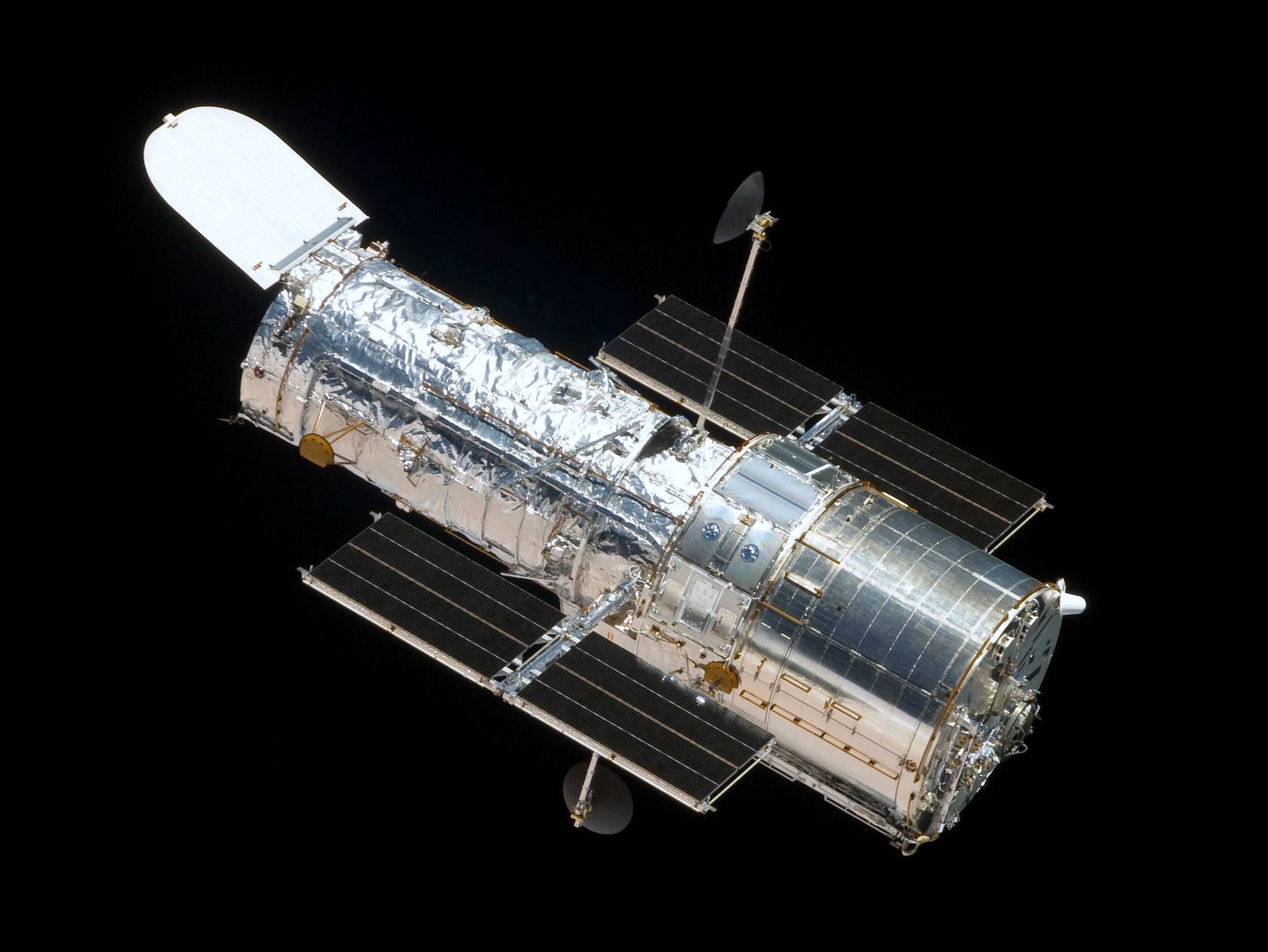
The Hubble Space Telescope seen from Space Shuttle Atlantis
Let's start with a brief history of Hubble. It is a space telescope that was carried into Earth orbit by the space shuttle in April 1990. It was named after American astronomer Edwin Hubble. Although Hubble was not the first space telescope, it is one of the largest and most versatile. Initially, the launch was planned for 1983 but technical and financial problems delayed the project. One of the most severe problems was the tragic disaster of the Challenger space shuttle. The explosion of the spaceship, which killed all the crew members, caused a three year break in US space travel and exploration.
When the first pictures from Hubble came through, in May 1990, scientists were horrified. The images were blurred - no better than the pictures produced by telescopes on Earth. Hubble's mirror was flatter than it should be by just one-fiftieth of the width of a human hair. In December 1993, Hubble was repaired in orbit. This was one of the biggest achievements of manned space flight. A series of corrective mirrors were fixed to the telescope in a series of five spacewalks. Below, you can see two pictures taken of the same galaxy before and after the repair. This shows you the huge difference in clarity.

Before and... after the 1993 repair
Since the repair, Hubble has sent back a series of stunning photographs of deep space, and has revolutionised our thinking about the universe. One of those really important images is the Hubble Deep Field (HDF), a series of pictures taken from a small and seemingly empty patch of dark sky. What could be so fascinating about staring at space like that? The fact that closer inspection of that emptiness revealed thousands of distant galaxies. Some of these are (were?) 12 billion light years away. The HDF has become a landmark image in the study of the early universe and has provided extremely rich material for cosmologists to analyse. The following video has been taken from the official site of Hubble. It explains the Hubble Deep Field and the problems that scientists encountered while capturing it. The explanation is clear and can help the layman like me understand the basic concept.
The language of this video is a bit hard. If you are a learner of English you might need the script here.
Although Hubble is almost twenty years old, making it quite old for a spacecraft, its best years are probably yet to come. According to this science article, the Hubble now "appears better than new after its final facelift by an astronaut repair crew" (Service Mission 4, the fifth and final human spaceflight to the observatory). So, we'd better be on the lookout for more news about astounding new pictures and discoveries.
Do some exercises about this post.